One teammate figures it out. Everyone can run it.
The best way your team does anything usually lives in one person's head — or one person's chat history. Rafter turns it into a skill: taught once, versioned, runnable from every teammate's AI tool.
Where good workflows go to hide
Someone on your team has already worked out how to close the month, onboard a client, or ship a release without drama. The steps exist — in their head, their notes, a chat scrollback nobody else can see.
So the workflow spreads by interruption: ask the person, wait, get a slightly different version of the answer each time. When they're away, everyone else's work gets slower and worse. When they leave, it leaves with them.
Teach it once, run it anywhere
A skill in Rafter is the workflow written down the way your team actually does it — the steps, the gotchas, the reasons behind the rules. Write it in the dashboard, or push it straight from Claude Code the moment you notice you've just done something worth keeping.
From then on it isn't documentation, it's behavior: any teammate's AI tool — Claude, ChatGPT, Cursor, Codex — finds the skill when the task comes up and follows it instead of improvising. Wiki links connect it to the memories and decisions it depends on, so the context travels with it.
When the workflow improves, you edit the skill. Everyone's next run uses the new version, and the version history keeps the old way inspectable.
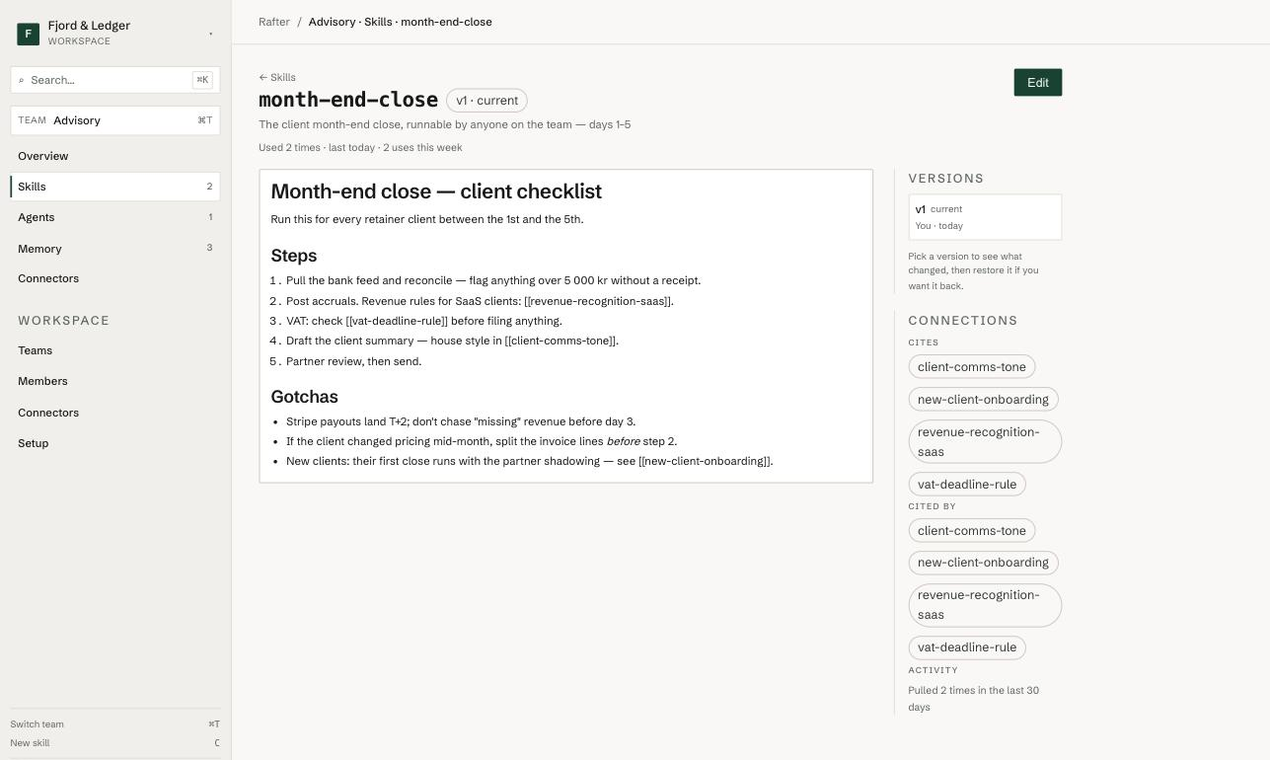
Documentation describes the work. A skill is the work — runnable.
What you’d actually type
- “Save what I just did as a skill: [the workflow].”From Claude Code or any connected tool — the skill lands in Rafter, named and versioned.
- “How do we [task]? Follow the skill if we have one.”The retrieval habit: search first, improvise second.
- “Update the skill — step 3 changed.”One edit; the whole team inherits it on their next run.
Two minutes to connect the tool you already use.From $29 per user — see pricing.
Connect your tools