Stop repeating yourself to your AI.
Every new chat starts at zero. You paste the same context, restate the same decisions, correct the same misunderstandings — and so does everyone else on the team, each with their own private version of the truth.
The context tax
AI tools are brilliant for the first ten minutes of a conversation and amnesiac after it ends. What your team decided, how your setup works, which client wants what — none of it survives the chat.
Per-user memory features don't fix the team problem. Your assistant slowly learns you — and still knows nothing about the decision your colleague made yesterday. Ten teammates, ten quietly diverging memories.
One memory, every tool
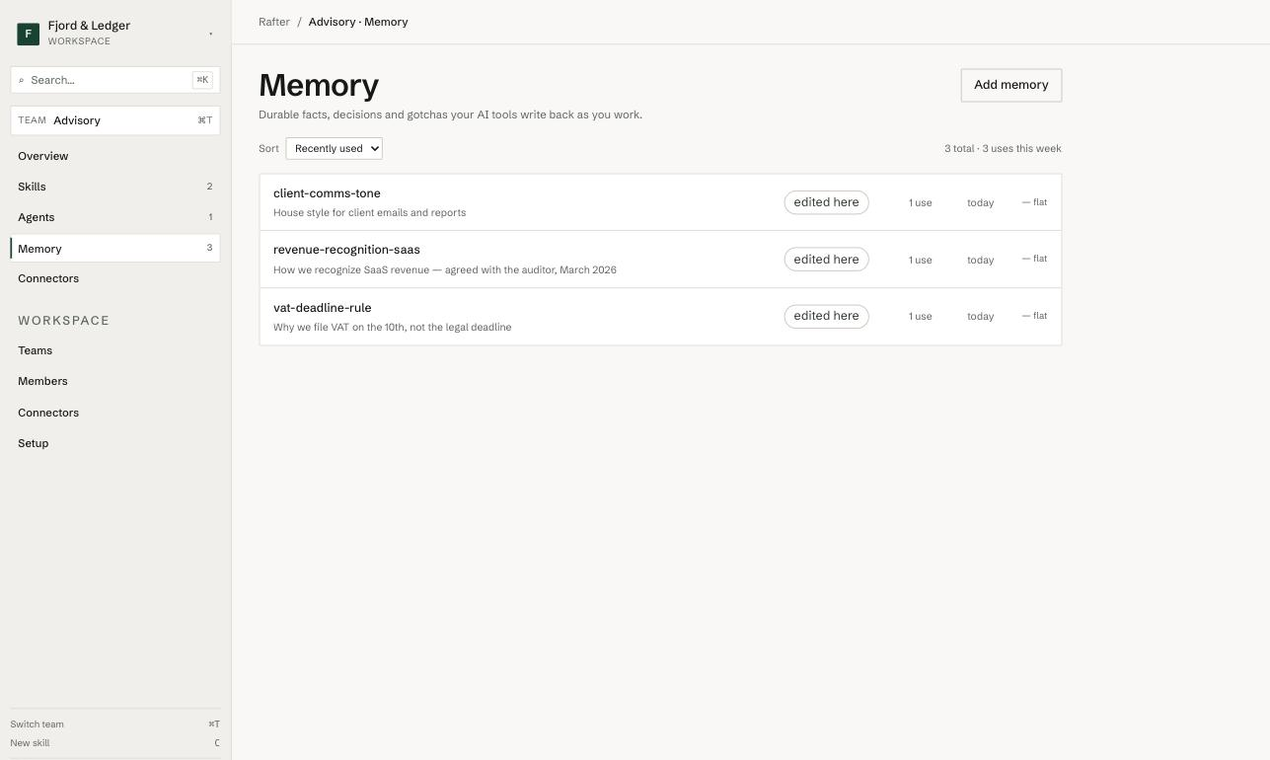
Rafter is one MCP server holding the team's memory: decisions, conventions, gotchas, client facts. Every connected tool — Claude, ChatGPT, Cursor, Codex — reads the same memory, and writes new learnings back as the team works.
Memories link to each other and to the skills that use them, so a fetch returns not just a note but what it cites and what cites it. Ask what the team decided about pricing and the answer arrives with its reasons attached.
Everything is versioned, and re-creating something a human deleted requires an explicit confirm. Agents write — the team stays in charge.
Your AI shouldn't know less about your team than a new hire on day two.
What you’d actually type
- “What do we know about [a client or project]?”Answered from the team's actual notes, with what they cite.
- “Save this as a memory: [the decision you just made].”Ten seconds now; the next person doesn't re-litigate it.
- “Why do we [rule]? Check Rafter before guessing.”The reasons live next to the rule — the graph keeps them attached.
Two minutes to connect the tool you already use.From $29 per user — see pricing.
Connect your tools